
The government on Thursday rolled out the internship programme on a pilot basis that will provide a total annual financial assistance of Rs 66,000 to those in the age group of 21-24 years, and aim to cover one crore youth over five years.
Macroeconomic management is usually a lot more comfortable with lower fiscal deficits. The sooner we get there, the better for the economy, says former Chief Economic Adviser to the Government of India Shankar Acharya.

It is time to take a few macroeconomic risks to kick start the growth.

A cut in government spending would come at the cost of growth.

Refraining from tinkering with tax and duty rates in the interim Budget, Finance Minister Pranab Mukherjee on Monday made a huge allocation of Rs 30,100 crore (Rs 301 billion) to government's flagship rural employment programme and many other schemes in a bid to counter the economic recession.

It had declined by slightly over 4 per cent in December. The city contributes 37 per cent to the total direct tax revenues. If the trend continues, it could affect the Budget estimates of Rs 13 trillion for the current fiscal year.
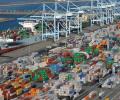
After remaining in the positive zone for three months, India's exports contracted 1.2 per cent to $33.98 billion in July, while the trade deficit widened to $23.5 billion.

In fact, no other recent Union Budget has held so much significance for the Indian economy as the one to be presented in about six weeks from now, notes A K Bhattacharya.

While the fiscal year has just begun, any windfall surplus will be welcomed by the government as it bids to meet the fiscal deficit target of 5.9 per cent of GDP, amidst lack of clarity on exactly to what extent will recession in the West impact India's trade and tax collections.

The government has exhausted only 39 per cent of its fiscal deficit target in the first half of FY24.

A combination of factors, including heavy investments in US Treasury bonds and dollar sales at a healthy profit, facilitated the Indian central bank in transferring a record surplus of Rs 2.11 trillion to the government for 2023-24 (FY24). The RBI's dollar purchases increased in FY24, supported by robust capital inflows endorsing the economy's health.
The 30-share Sensex ended up 219 points at 18,620 and the 50-share Nifty ended up 63 points at 5,472.
The main gainers on the Sensex were Bajaj Auto, TCS, Cipla, HDFC, HDFC Bank.

India's fiscal deficit reached 4.11 trillion rupees ($61.67 billion) during April-October or 74 per cent of the full-year target, government data showed on Monday.

The government's food subsidy in the ongoing fiscal year is expected to be a little less than Rs 4 trillion.

A ramp-up in COVID-19 vaccination, healthy advance estimates of kharif (summer) crop and faster government spending were the factors which led to the revision, the agency said in a statement. It can be noted that after the 7.3 per cent contraction in 2020-21, there were expectations of a higher growth number in 2021-22.

Strategic sales are tricky and were last undertaken when the Vajpayee government was in power.

The government has budgeted to cut the fiscal deficit to 3.3 per cent of GDP or Rs 6.24 lakh crore in 2018-19, from 3.53 per cent in the previous financial year.

The Budget decides to take the lead in revving up infrastructure.

West Bengal is home to 43,000 Durga Pujas, and the business around it is a major economic driver.

The Indian Railways will earn a profit of Rs 951 crore (Rs 9.51 billion) in 2009-10, down 93 per cent from the 2007-08 level.
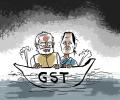
Rates may be raised from 5 per cent to 8 per cent and 12 per cent to 15 per cent. The Council can explore possibility of merger of slabs to bring down the number of slabs to three. The Central GST collection fell short of the Budget Estimate by nearly 40 per cent during the April-November period of 2019-20

The main responsibility for producing the Budget rests with the Budget Division of the Department of Economic Affairs in the finance ministry

A communiqu sent by the department of investment and public asset management (DIPAM) to the heads of all PSUs, said the move would help the government to get predictable and periodic dividends before Budget estimates are firmed up.

Long-term capital gains tax may be scrapped and the burden of dividend distribution tax could perhaps be shifted from companies to shareholders. Also, the Budget could provide income tax relief for the salaried classes, while proposing tax sops for small, medium and micro enterprises.

It was 55.3 per cent for the same period last year, and data shows the fiscal deficit for April-May was kept in reasonable check in spite of heavy frontloading of expenditure.

'Interim Budget has ignited the entrepreneurial spirit.'
The Indian Constitution requires the government to present to Parliament a statement that shows separately the expected revenues and expenditures, both current and capital by heads of account.
The Budget process is a massive exercise. The exercise has different stages and each stage kicks off at a different stage of Budget making process.

There are doubts about the meeting of indirect tax collection target for the current fiscal as there is slowdown in the economy.

Govt looks at more taxes, dividends to meet deficit target.

This is slightly better than the fiscal deficit position last year when it was 85.6 per cent of the Budget target.

The Budget emphasises on capacity building and empowerment of marginalised sections of society including farmers.

In the last budget, then finance minister Arun Jaitley had allocated Rs 85,010 crore for the education sector which was later revised to Rs 83,625.86 crore.

Outlay for infra is also expected to see a significant increase in view of the government's Rs 111-trillion investment plan under the national infrastructure pipeline to develop social and economic infrastructure over five years.

Most brokerages are betting that the new government will shift to a policy focussing on boosting rural incomes and consumption since that has clearly been a pain point.

There is a link between objectives and commitments.

Against a turbulent and uncertain background, Budget 2017-18 hewed a steady, forward-looking course, says Shankar Acharya, former chief economic adviser to the government.

Maharashtra is the BRS' first target.

On the revenue front, the finance ministry was expecting higher proceeds from non-tax revenue.
